11.27.2013

Google Earth for ya Head

Brain iz confusing place.
ichcb, via flickr


My friend Katherine called my attention to this fun little exercise: the brain represented as a subway map, as imagined by artist Miguel Andres and picked up by Know More, an offshoot of the Washington Post's much-loved Wonkblog. Unfortunately, I told her, I have to disavow it completely. (Sorry if you just spent 5 minutes memorizing it.) It's a darn cool idea, but it's not a teaching tool.


I'd say (somewhat generously) that it's about 30% right on anatomy, 20% on functional localization, and -- most damningly -- less than 10% right on how the brain actually works. It's more misleading than informative.

I don't know whether Andres ever hoped it would be used at a place like Wonkblog; it could have been just a creative work, by which standard it's cool enough. But since it was, and now it's going around the web, I'll try to 'splain what it does wrong.


Anatomically, it's a crapshoot. For one thing, it seems to say that analogous systems on opposite sides of the head are doing totally different things. This isn't true. Now granted, while the old "left brain vs right brain person" thing is deeply exaggerated, it's true that the two halves of the brain do subtly different, but coordinated, things. However, those processes are usually complimentary -- for instance, the area on the left that does language production, called Broca's area (hence the reference on the map), has an analog on the right that does pitch inflection, and other "non-verbal" communication stuff.

But then half the time, this map's routes are just totally unrelated to how the brain is actually set up. Not only don't your eyes go straight to different functions, input from your eyes goes ALL THE WAY TO THE BACK OF THE BRAIN, with a stop or two in the middle, to do visual processing. The image we reconstruct is then passed forward into the brain to do things like physical spatial awareness, object recognition, etc., and then further forward still to do things like emotional associations, decision-making, etc.
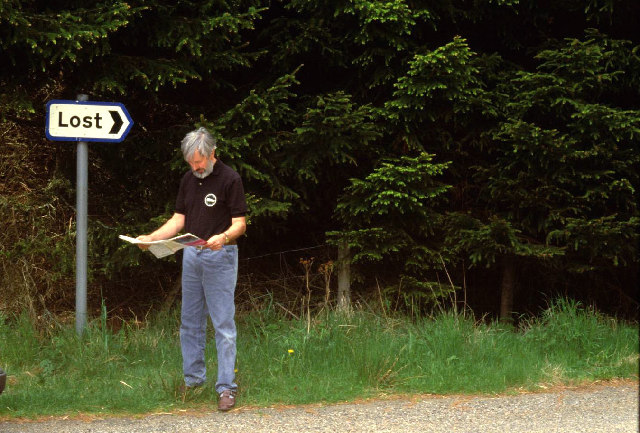
Where this map will get you.
Peter Ward, via geograph

The biggest problem is that looking for a particular instantiation of something, like "aggression," isn't gonna get you anywhere. You want to look at "mood," or "social cognition"? Well we're still arguing about it, but at least we believe there are areas within networks that might underlie stuff like that. Pointing at a brain region and saying "aggression" is like looking at a computer motherboard, pointing at an area and going, "PDF." It's like what, no.

Also, doing a 2D brain anatomy lesson is hella hard, cuz... it's not a 2D organ. Imagine doing a subway map, only instead of stops being at intersections, they're at offices. ("The next stop is: Lexington and 53rd. And the 26th floor.") Not the easiest thing to stick on a poster or a t-shirt.


Disappointingly, scientists are often pretty bad at this kind of thing, surprise. Arguably the best free, lay-centered thing you can get on neuro right now is the Brain Facts book published by the Society for Neuroscience (SfN), a professional organization. But it's not exactly "multimedia," and BrainFacts.org in general is a great idea, but it doesn't seem to be a lot of centralized learning resources so much as a feed of relevant articles.

This little feature, on the other hand, is kind of fun and to the point -- but it's talking about the project neuro researchers are currently tackling, not delivering the latest approximation of their results in an intelligible or interesting way. And it also brings up kind of an interesting analogy -- Google Earth.

Google Earth is an official product, obviously, but the dorkier among us remember when it had alpha and beta stages, and a lot of that was available to the public. They release funky little plugins now and again, like last year when they made an ancient Rome map you could overlay over the modern-day area. And when we look at 3D Manhattan and the buildings are wonky and the textures don't load, we're slightly peeved but much more amused. We want to play. And play we did, to the point where Google collected a lot of feedback by farming their testing out to interested people.

Making something similar for the brain would be a great outcome for neuro in the next decade; it's just harder because a) scientists are more afraid of being wrong than app developers, and b) people know what Manhattan looks like without Google Earth. We can't really say the same for, you know, the left inferior parietal lobule. Plus, a road is pretty easy to interpret; the brain's function is way less obvious a consequence of its structure.

...

HOWEVER! A Google search revealed that we do kind of have something like this now! Much excite! It's called the BigBrain, and it was rolled out in June of this year thanks to folks at Research Centre Jülich and Heinrich Heine University Düsseldorf in Germany, and the esteemed Montreal Neurological Institute at McGill University in Montreal. I'm going to be playing with it a lot. As for the functional part -- you know, getting off the brain train at "social cognition," etc. -- we've got a ways to go. Thanks in part to the BRAIN Initiative, however, which I'll discuss in another post soon, we might be just years away.

My only reservation is that a physical reconstruction, while hugely important and useful, isn't that interpretable a map (especially to non-neurogeeks). Cartographers, demographers, etc. are huge, lucky nerds because they get to fiddle around with how to present geographic information in the most novel and informative ways; to them, Diffusion Tensor Tractography is a map they'd want to delve into, whereas the BigBrain is more like satellite images of a mountain range -- nothing's highlighted for you. However, I'd bet the tractographic equivalent is right around the corner.
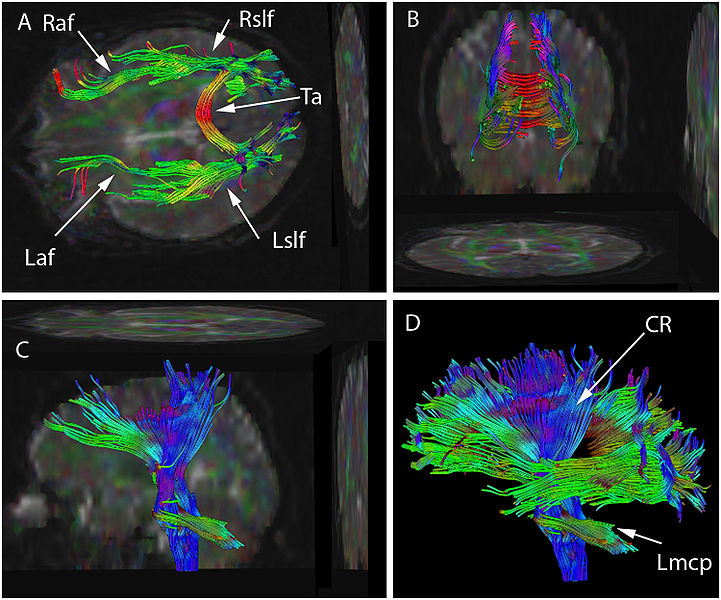
Now THAT'S worth taking for a spin, amirite?
AFiller via wikimedia
Anyway. I'm pumped for the neuro community to come together over the next few years and democratize this knowledge, even if, as the subway demonstrated, it won't always be easy. But hey, everybody should be able to have the same fun we do -- taking a hike in unexplored terrain, and getting wonderfully, confoundingly lost.

11.12.2013

Significance is... Significant. But Also, Not Everything.

A post in which I write about statistics for non-scientists, and then stick it to the man. Gently.

Fun things you'll learn to impress friends at parties:

  • statistical power
  • effect size
  • my true place in the academic food chain
  • that you kno nuthin, Jon Snuuuu

The Incubator, a science blog at the Rockefeller University in New York, just posted a link to this paper by aggie Valen Johnson about the somewhat foggy standards for statistical significance in science. PSA: you should check out the Incubator, it's great; and my friend and former classmate Gabrielle Rabinowitz writes and edits for it!


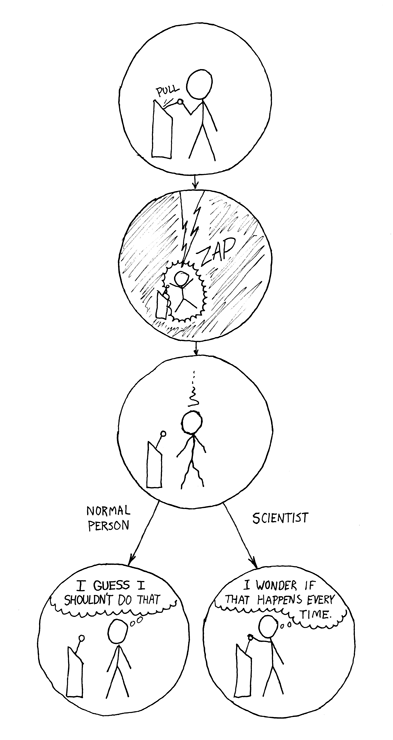
Another XCKD, because look at it.
Personally, I think that if we only taught one science/math class to all Americans (though heaven forbid), it would have to be statistics. Since stats is the study of things we are too dumb, too big, too small, too slow, etc. to do perfectly -- e.g. make accurate predictions, snag individual molecules, measure the economy, or anticipate a dice roll -- it is one of the most powerful and simple ways of becoming smarter than one person's worth of day-to-day experiences can make you. Simply put, most people can't gather enough accurate data to reliably know what's happening outside the bubble of what they can see, hear, and touch.

An even more important lesson stats teaches is that everything we "know" is really only known with some degree of certainty. We may not know what that degree is exactly, but we can still get a sense of how likely we are to be wrong by comparison: for example, I am much more confident that I know my own name than that my bus will show up on time. However, as a lifetime's worth of twist endings to movies can tell us, there's still a teeny-tiny chance that my birth certificate was forged, or I was kidnapped at birth, or whatever. Years of hiccup-free experience as myself provide a lot of really good evidence to believe it's true, and if my family and I were to get genetic tests, that would make me even more confident -- say, I'd go from 99.99999% sure to 99.9999999999%. May seem arbitrary, but that's still a million times more confident. And even though I don't feel that way about my bus I'm yet more confident that the bus will show up on time than that most political pundits can predict the next presidential election better than a coin toss. (Come back, Nate Silver.)

When scientists conduct significance tests, we're basically doing the same thing -- we want to know the truth, but instead of saying "when this happens, that other thing happens," we want to say, "this reliably precedes that," and if possible, "this reliably causes that." The last one is a lot harder, but as for what constitutes "reliable," or "meaningful," the word we use is significant and by convention we say an effect is significant when it would only happen one out of twenty times if it was just by chance.

Now, you don't have to be a scientist to see both the pros and cons in this strategy. Obviously, one such experiment on its own doesn't so much prove anything as make a statement about how confident we are in our conclusions. The lower the odds of something happening just by chance, the more we feel like we know what we're talking about. For example, rather than use the 1 in 20 cutoff, physicists working on the Higgs Boson had enough data to use a benchmark closer to my confidence in my own name. And in recent months and years, the science community, especially in the life and social sciences, has become more and more suspicious that our confidence is too high -- or put another way, that things we say could only happen by chance one in twenty times could actually happen a lot more often. That maybe the things we think are real, are sometimes wrong.

Scary, innit?

Well, it seems reasonable, then, to do what that paper is proposing and move the goal-posts farther away, so only stuff we're reeeeeaaaally confident in will pass for scientific knowledge. But there are big hurdles to this -- some practical, some theoretical. First of all, just like we can calculate how likely something is to happen by chance, we can calculate how likely we are to see how unusual such an event would be. If buses can all be late sometimes, and vary in how much, how many buses would I have to take to say that the 28 line is more likely to be late than the 80, and I didn't just take the 28 on a rough week -- even if I'm right? (Right now, all I have is a feeling, but just you wait.) The odds that I'll be able to detect a significant difference where such a difference exists is called statistical power. And it's one of scientists' oldest adversaries.

See, most science labs are pretty small, consisting of a handful to a few dozen dedicated, variously accomplished nerds, under the command of one or two older, highly decorated nerds. (Grad students are whippersnapper nerds who have only demonstrated we have potential, though collectively we do a lot of the legwork.) Most labs don't have all that much money, depending on the equipment we have to use, and we don't have that much time before we're expected by the folks who control the money to publish our results somewhere. It's not a perfect system -- that critique is for another time -- but it works okay. Yet with the exception of really big operations like the public is often familiar with, projects like the Large Hadron Collider and the Human Genome Project, or labs whose subject matter lends itself to really high 'subject' counts like cell counts or census data, it's really hard to get enough rats, patients, elections or what-have-you to guarantee you'll detect any tiny difference that is really there. A lot of fields, including and especially neuroscience, are slaving away the months and years in lab on experiments where, even if they're right, the odds are they won't be able to tell.

So the idea of moving those goalposts way out there, while in many ways very necessary, also necessitates a huge shift in the way science is funded and organized. Studies would need to be much larger, there would be fewer of them (which would restrict individual labs' ability to explore new directions or foster competing views), and money would tend to be pooled in really big spots. We know -- exactly because of successes like LHC and HGP -- that this can work, and indeed might be the only way to ensure that certain parts of the controversialif dialed-down, BRAIN initiative by the White House will yield anything concrete. There's no question, though, that some disciplines would be hit harder than others with such a change.

But that pales in comparison to questions about the role p-values, which are those odds that it happened by chance, should play in how science is published and reported. They may be the gold standard to which science has aspired for the better part of a century, but I think they can only really paint a complete picture with some help.


***


Last year I had the privilege of working on a project with classmates at the La Follette School of Public Affairs, part of UW-Madison, that tried to estimate how much value would be generated by a non-profit's efforts to provide uninsured kids with professional mental health services, right there in their schools. In order to estimate that, we needed to know not just whether counseling helped kids, but how much it helped. So in looking through the literature on different kinds of mental health interventions and how well they treated different mental illnesses, we often focused on effect size, which is a measure of how big a difference is. It sounds related to significance, and it is, but here's where they diverge. Let's say that we want to know whether Iowans are taller than Nebraskans. We go and take measurements of thousands of people in both states, giving us really good power, so if there's a difference we'll probably see it. We find that a difference exists, say that Iowans are really taller. We also know that based on our samples, the odds are less than one in a thousand that we just happened to pick some unusually tall Iowans. Great job, team!

But... what if Iowans are, on average, less than a quarter-inch taller? Even if we're right, who cares?

That's what we wanted to know for our research -- if these kids see counselors regularly enough for therapy to work, how much better will they get? Once we'd read the work of countless other researchers, we had a pretty good idea, and we used that in our calculations. (As a side note, we found that the program probably saves the community about $7 million over the kids' lives for every $200,0000-costing year it runs -- in other words, it's almost definitely a good call.)

But effect size isn't what makes your work important. In most cases I've seen, it's not even reported as an actual number. In fact, as a graduate student with several statistics courses under my belt, I never formally learned how to do it for class. I figured it out, and applied it to datasets and published results, for the first time for that project.


What different effect sizes look like.
via Wikipedia.
For those who are wondering, briefly: effect size (at least, as expressed by Cohen's d) is how big the difference is, expressed in standard deviations in the variable's distribution. In other words, if people in Iowa are 5'11 plus or minus four inches, and people in Nebraska are 5'10 and 3/4, the effect size is 1/4 inch divided by four inches = 1/16, or .0625. In contrast, the effects of therapy on mental illness are on the order of 0.5 - 1, or about ten times larger relative to the underlying average.

Significance is what makes differences believable; effect size is what makes them meaningful. And power, the other number I think should be estimated and reported, shows how well-prepared a study was to find a real effect -- which, especially for studies that fail to confirm their hypotheses, would provide a measure of rigor and value to their publication. While science has, correctly, always strived to prove its best guesses wrong before declaring them right, it's about time we got a sense of whether the status quo is right either, and whether either answer matters.

However the scientific establishment, despite much wailing and gnashing of teeth, is, like any large institution, having a hard time moving forward with such sweeping normative changes. It's taken Nobel Laureates, brilliant doctor-statisticians with axes to grind, and dramatic exposés of mistaken theories and sketchy journals to make our systems of measurement a real issue in the science community. I feel strongly about this, but I'm just a grad student: a foot-soldier of science training to become an accredited officer. So I'm glad people, like the author of the article that kicked off this post, are continuing to publish seriously about it and propose real changes in the community's expectations.


I'm just here to say, I think most of the changes on the table are only part of the picture, and wouldn't succeed on their own. We need standards for reporting effect-size and power, so we can see for ourselves what the truth really looks like.

10.09.2013

Dogs are (like) people. Blobs are not feelings.

I saw this article in the New York Times, by Emory researcher Gregory Berns, come up on my newsfeeds in the last several days, and I've gotten emails about it from friends and family. After thinking it over, I couldn't let it pass without comment.

As anyone I know could tell you, I am a dog person. To an unhealthy extent.
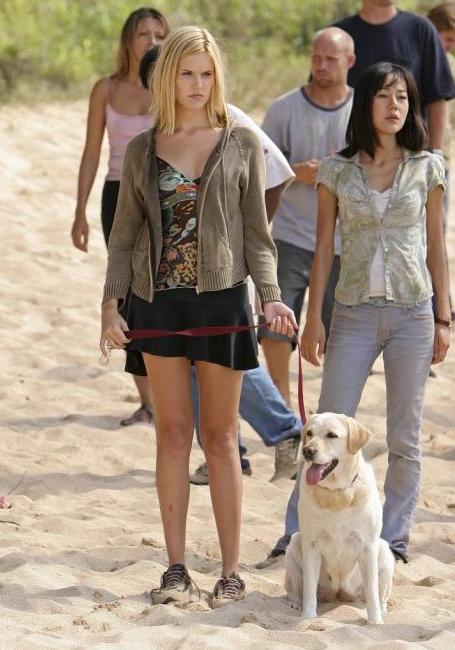
Don't look, Vincent...
via Lostpedia
  • The only time I cared about anyone in Lost was when the dog Vincent tried desperately -- and ultimately in vain -- to follow his human friend Dawson, who was leaving the island on a raft, into the ocean.
  • If there is a dog at a party, I will begrudgingly leave it for a few minutes at a stretch to interact with my human friends. I would rather just lie on the floor with it, in whatever clothes I'm wearing, and pick up its vibe.
  • I will also play with it until parts of my body stop working, and usually only when somebody points out that fact out of concern for my continued health.
So when I initially saw Berns' article, and the subject it broached, I was pleased! Yes, I say, let's consider the question of whether dogs are people. Personally, I think that's too simple a proposition to capture the truth, but we'll get to that.

The bottom line of my reaction is this: I appreciate what the article was trying to do -- and unlike a lot of scientists I know I don't say this next bit a lot, because popularizing science isn't always bad -- but I found it really inappropriate in tone, scope and scientific content.

The elements of neural activation Berns was citing basically correspond to evidence of pleasure, reward and motivation. (My friend Ryan, who works on animal behavior in rats, points out that regardless of what they actually can do, the dogs in question weren't demonstrating "love and attachment," they were demonstrating "preference.") The caudate, which is part of a structural assembly called the striatum, interfaces with some of the evolutionarily oldest structures in the mammalian brain. As per the experiments on drugs and rats in a recent post, these areas -- while varied in their exact purposes and connectivity profiles -- largely support the dopamine-powered "reward" circuit, technically called the mesocorticolimbic pathway. I'm not an expert on it, and I'm fuzzy on the caudate's specific role within the circuit, but Ryan agrees Berns' attribution to it of such nuanced emotions (much less personhood) is an overreach.

Yes, it's swirly. Brains are weird. via Brainposts
In a very crude sense this circuit is the reason we do anything -- without integrating a sense of motivation and anticipation of reward into our value judgments, we'd be so apathetic we wouldn't bother to eat, and we'd just die. It's also the circuit implicated in drug addiction, or for that matter, *anything* addiction. In many cases, the kinds of things that circuitry is responsible for are the impulses we actually need to fight to be considered persons, at least in the conventional moral sense. If you've heard the phrase "he was behaving like an animal," there's reason to believe the culprit was, colloquially speaking, letting his striatum drive the car unsupervised.

If anything, what we need to show dogs are people is indication of "higher" functions, or whatever you want to call them.

Side note: personally, I think the moral significance of living beings occurs on a sliding scale, where a goldfish registers and its well-being is worth something, but isn't equal to a person; and a dog is closer to people but generally comes up slightly short (though sometimes very slightly... and maybe there's some overlap, with dogs I'd choose to keep alive at somebody else's expense). Some other blog post I'll explain how I see this as consistent with Giulio Tononi's work on consciousness. Other scientists, including my one-time boss Julian Paul Keenan and his mentor Gordon Gallup, have considered the value of using self-consciousness (as determined by the ability to understand the significance of one's own reflection in a mirror) for one of the criteria of "personhood." The point is there are a lot of ways of approaching this problem, and few of them are simple, which stems from the simple fact that people are complex. (*snap*)
Complexity. Deal with it.
via WiffleGif
Anyway... if we hypothetically bought Berns' reasoning, i.e. that evidence of comparable activation patterns in comparable cognitive paradigms is evidence of comparable function, and thus personhood (which can get a bit fishy), I argue we'd need a lot more and better benchmarks. We'd need dorsolateral prefrontal cortical activity, indicating self-control and abstract thinking. We'd need ventromedial prefrontal activity, and insula, maybe anterior cingulate -- or their homologues, anyway -- corresponding with complex emotional responses, especially social ones like guilt and empathy, being part of dogs' decision-making processes. After all, these are among the things people say separate us from animals.
All four areas -- ventral striatum (VS), ventromedial prefrontal cortex (vmPFC), insula (INS), and anterior cingulate cortex (ACC) in one handy, murderous image.
Front of head is to the right. via PLoS ONE, h/t Al Fin.
But we probably shouldn't buy Berns' reasoning. That's because:
  1. If you're going to try to build homologues, most of the time mammalian brains -- which are, after all, like a series of iPod models with incremental improvements -- will roughly line up, so you'll have something to compare. It's really a question of how developed and interconnected those areas are. Or at least, we know it'll probably be a combination of tricky things.
  2. Dogs are generally going to be able to do, and show activation in, a lot of the simple tasks we use in humans, simply because making really sophisticated experimental designs to probe thinking and feeling is complicated. Neuroscientists and psychologists have to constantly refine and revise experiments to ask more and more specific questions.
  3. Dogs don't have parts of their brains that don't work. NOTHING does. Brains don't have areas that can't be made to "light up" under the right circumstances. If we did, those traits would be selected against in evolution, because we'd be burning calories with useless brain matter that we could've used for something else. (Next time somebody says we only use 10% of our brains, hit 'em with that.)

Judges? Bzzzzzzzzzzzt.

So ultimately, this is like... well, it fails to expand on anything we don't already know about dogs from just hanging out with them, for the most part. Except that there are some commonalities in what areas do what things, which we always would have expected to see. And on top of that, Berns used one of the relatively few structures, outside of sensory areas, that we couldn't use to persuasively argue that dogs share some of the most important aspects of personhood.

And just to wax advocate for a moment here, the sentence "by looking directly at their brains and bypassing the constraints of behaviorism..." makes Ryan, generally a very peaceful person, very inclined to violence. Without behavioral research, we wouldn't know (or continue to learn) about what makes animals AND people behave the way we do, and how our brains work that magic. Nobody is saying we should all think of people like Skinner thought of rats. The only thing imaging provides in this context is a more global perspective on neural activation patterns during that behavior. And I'm an imaging person saying that!

Look, lots of people criticize neuroimaging researchers for vastly overreaching in their claims based on relatively fuzzy, and difficult to interpret, imaging data, and this is a perfect example of that. So while I in large part agree with the premise of the article, I completely disagree with how Berns arrived at it, and how he depicted the science that brought him to that conclusion. I'm pretty disappointed with the article as a high-profile outreach on behalf of the science community.


Next time, maybe I won't have to be so ruff on him.

Yes, I'm here all week.

10.05.2013

Rat Park: Science Caper or Curio?

caruba via flickr, h/t to Joe Kloc
Funny that this was the thing that got me back to my blog after an extended hiatus (though I've got like 4 drafts 80% done in the pipeline, waiting for polish). Procrastination can work wonders.

My friend Ryan, a fellow neuroscience grad student working on reward, motivation, and addiction using a rat model, pointed me to this blog post. The writer is Tom Stafford, one of the two authors of the popular science book Mind Hacks, and a researcher at the University of Sheffield. The post recapped a series of studies conducted in the '70's by Bruce Alexander and colleagues at Simon Fraser University, in which they built their test rats a large, well-furnished playpen, then tried to replicate classic drug addiction studies.


What they found, as Stafford describes, surprised them -- the rats living socially in the open, enriching pen actually avoided drinking water laced with morphine, instead of consuming the drug to the exclusion of nearly all other behavior. Stafford also points readers to this comic by Stuart McMillen that illustrates the story. Stafford then concludes the post by musing, among other things, that "even addictions can be thought of using the same theories we use to think about other choices, there isn’t a special exception for drug-related choices."


Okay, so. We've got a lot of crazy ideas kicking around here, so let's take this slow.


First off -- while I haven't read Mind Hacks, Stafford appears to be a pretty accomplished researcher, and my default position is to be glad that people are writing fun science books unless and until I have reason to suspect they're doing more harm than good. After all, I wouldn't have heard about this if not for his post. McMillen's comics likewise seem fun and clever, and remind me of a more serious counterpart to nerdy staples like The Oatmeal or Saturday Morning Breakfast Cereal. (If you haven't seen these -- not to even speak of XKCD -- run, don't walk, to way funner and smarter nerd porn than anything I've done yet. Go ahead, close this tab.)


With that out of the way, I'm... not placated by the story here. There are a number of reasons for this. In order of increasing discomfort, here they are:


(Note: apologies for linking to academic papers. I know many would-be readers don't have access to them. If you're affiliated with a University, try searching for them using your library's website; if not, try to reach out to somebody you know who is.)

  1. While the role of context and social structure in drug abuse is still not a big enough issue, it isn't anything new either. Drug addicts who enter rehab clinics, get clean, then go right back to their old stomping grounds are surrounded by people and paraphernalia that remind them of their temptation, which can undo all their progress. Going beyond addiction, behavior of all kinds can be triggered almost automagically just by finding yourself in familiar settings -- as anybody who's moved and then started to drive home to the wrong house can attest. And I can't even begin to broach the social science literature on the influences of socioeconomic status, education, access to healthcare, etc. on propensity for drug use (here's just one example out of hundreds). So implying the ideas derived from this study should rewrite the rules on addiction is a sizable overstatement.
  2. The biggest question-mark in this article, and the statement that I think needs the most gratuitous linkage, reads "There have been criticisms of the study’s design and the few attempts that have been made to replicate the results have been mixed" [emphasis added]. The fact that literally the subsequent sentence hand-waves that away -- "Nonetheless the research does demonstrate that the standard “exposure model” of addiction is woefully incomplete," -- using such strong language to criticize a whole field seems, to me at least, way off-base. You don't say a model (even a simple one constituting only part of prevailing theories on drug use) is "woefully incomplete" because of a 40-year-old paper with replicability issues, and you certainly don't say that without at least pointing readers to those attempts to replicate.*
  3. To say that rats could be put in any environment where they'd stop taking drugs entirely, given a choice and even encouragement, is a seriously bold claim; or at least it is today. In the decades since those studies were conducted, rats have been -- beg pardon, for folks who have concerns about the ethics of animal research -- tested on every drug under the sun and given practically any task imaginable, and a huge portion of those results have translated pretty well into human findings. An entire literature has emerged on the science of reward and addiction, a field in which Ryan and his mentors, Brian Baldo and previously Kent Berridge, are participants. And we've got pretty solid ideas about the systems in the brain where these behaviors are generated. So it would require more than a little replication to validate those claims.
  4. Most unsettlingly, there seem to be some oddities about the experiments and the way they're being presented. Correct me here, dear readers, if I missed something.
    • In McMillen's comic, he writes that Alexander et al. "covered the floor with fragrant cedar shavings for the rats to nest in". When Ryan and I read that, we Macaulay Culkin'd so hard: cedar is toxic.
    • quicheisinsane via flickr
    • Here's an example of one such finding. A 1997 review of bedding materials in labs around the world found that pine shavings were extremely cytotoxic compared to corncob, straws and other materials. In fact, a paper published as early as 1968 -- that's almost a decade before the Rat Park experiments -- found cedarwood to be a bad environment. If it's true, then, that the bedding was cedar, then Houston, we have a problem.
    • Even more confusing, the paper linked to in Stafford's post said the floor of the pen was sawdust -- different, but still linked with a few major respiratory problems. So was McMillen reading a different paper? Did the research team use different bedding systems in their different studies? It looks like the latter, based on this 1981 study that mentions cedar shavings. (Once again, though, since I'm not an expert I don't know how these problematic conditions would affect the results; they just add a lot of uncertainty, and speak to the possibility that there were unaddressed or as-yet-unknown problems in their methods.)
    • *For the interested, here's a thesis published in 1985 that suggests that "during a colony conversion the supplier inadvertently introduced strain differences making the present rats more resistant to xenobiotic consumption." It's only one non-replication, but even so I didn't have an easy time finding it.

So in general, the post made me a little uncomfortable at times, and the study did too. When it comes to a topic as stigmatized as drugs, there are always people with pet opinions looking for validation; so while nobody should be hushed, everybody should try to speak carefully. Implying that we can think of drug use as a totally non-compulsive act, and therefore subject to the same moral culpability as all other actions, is a proposition the neuro and psych communities have spent years and years trying to overcome. Drug courts, which have experienced so much success as alternatives to prison, were only made possible by thinking about addiction as a problem to fix, not a sin to punish.

To say otherwise -- to put all that progress at risk -- should not be done lightly.

11.21.2012

Your brain is like a board meeting

...grayish, quarrelsome and grudgingly efficient

-----

Post # 2, a long time coming.

Like most productive things I do these days, this comes as a means of procrastinating slightly more productive things. However, I've realized I don't just need an outlet, I need a place to give voice to the kinds of ideas that are stirring around despite the fact that I haven't yet acquired the requisite professional accreditation.

Note: now that I'm affiliated with a university and a research group, all views posted here are my own.

I'll start smallish, since tackling any one of the main spiels I've been working on is daunting. Let's do some fun facts. The heavier stuff will come later.

You're not like Other People. You monster.
Everybody talks about brains these days: lawyers, supplement marketers, educators and doting suburban moms, and many more. But when I say I'm doing neuroscience in graduate school, people sometimes literally take a step back, as though I'm this radioactive mad genius. I'm here to tell you -- brain science isn't brain surgery, and for that matter while brain surgery is dang hard, that's probably more as a result of the skills required -- complete mental focus, steady and dexterous hands, unerring step-by-step procedural thinking, grace under pressure etc. -- than the pure knowledge.

What we've learned about our squishy mind-sponges in the last century or two is incredible, but it was acquired at a slow grind, and so while expertise is still expertise, I think anybody could learn about 50% of everything we brain folks have to tell you (that's useful in daily life, anyway) in a weekend or two, if it were just laid out properly.

Let's play MYTHBUSTERS! I'll do a round every now and then, since I don't just want you to know when they're wrong, but how wrong they are and what's actually right. Sadly, I can't offer you death-defying pyrotechnics in blog form, but bear with me.


This is your brain on drugs. Though probably the normal amount, and 20 years ago.

    Round 1: We only use 10% of our brains.

    No ma'am. Or at least, not in the way this implies. In fact, we probably use most of our brains most of the time -- for any given task, there are a huge number of areas that work together to support that function, and every area seems to be involved in a ton of different tasks. I loves me some analogies, so while you, dear reader, will hear many if you're the kind to just read a million entries back-to-front at 2 in the morning, I'll start with one that's popular right now.

    Your brain is like a group of people. Think of your stereotypical all-hands business meeting, for instance. You've got a bunch of different specialists all engaged in conversation to try and tackle a series of problems for that week. When the boss brings up an issue, generally everybody will try to weigh in with their perspective -- the budget people on bottom line, the PR people on publicity, engineers with logistics, and so on. Sitting quietly and playing Fruit Ninja isn't how they get themselves noticed and their concerns heard, even if they're not experts on this particular question. When the topic changes, different people become more prominent, but everybody's got a role to play.

    Well ok, so I guess that's the opposite of true. Save your employees, wear a bike helmet.

    That's why those blobs you see showing an area "lighting up" during a particular task are so hard to get and interpret -- the whole brain is generally active, and you're only seeing the areas with a 1%, 2%, maybe a 5% increase over the usual amount. So in the end, it's the sum of everybody's contributions that matter, and anybody who trumpets "SCIENTISTS FIND BRAIN CENTER FOR POLITICAL PARTY" is blowing smoke.

    That's all for today, off to a meeting. (With a person. That kind.)