6.07.2016

Wonderful Swedes, Workable Science

If y'all haven't already discovered The Weeds, Vox's policy podcast, OMG you don't know what you're missing. It's like the antidote to the vitriol and despair of American politics: detail-oriented discussion of nuts-and-bolts policy on the level of people who actually do that work. While Trump and Clinton and Sanders exchange body blows, the business of governing quietly carries on in Federal, state, and municipal offices around the country, and it's reassuring to remember that and learn what the cutting-edge ideas are in how best to advance that business.

In their May 27, 2016 episode, they discuss a shiny new paper using the near-omniscience of Swedish administrative data to estimate the effects of psychological trauma during pregnancy on the mental health of the child when they reach adulthood. It's cool. But in the most recent episode from June 3 (middle show segment), they note that the paper in question has been called out for failing to acknowledge its intellectual forebears, possibly in an effort to appear more novel than it actually is. Matt Yglesias and Sarah Kliff then capably recap some of the key questions in the replicability crisis that's kept the scientific community up nights lately. And that means that for a hot minute this became a science policy podcast, which of course got me all heebly-jeebly.

They do a great job of explaining, to a policy audience probably not as obsessed with this crisis as sciency types have been, how incentives to publish ever more novel and controversial findings may have rendered suspect a considerable chunk of research in the last few decades. I'm super glad for that, and am totally stealing Sarah's "hot take machine for the academy" line. However, one important thing they don't touch on is the good reasons the system came to look like this in the first place.

What we fear when we talk about the value of original research is not replication; it's duplication. Not so much in the sense of fraud or plagiarism, though those are certainly undesirable, but rather in the sense of research on a treadmill, wherein a failure to learn the history of one's field leads to wasted time and energy reinventing the wheel. I get the sense that this is one area where scholarly work is genuinely better than most opinion journalism, even the data-driven variety: if you usually have to cite 100 other papers to publish an article, there will typically not be a gigantic surplus of articles on a subject (and yet even despite that, it feels like that sometimes), and you will probably not miss giant chunks of important information, all of which leads to efficiency and centralization in the field.

As an exercise in contrast, consider this article from the right-wing blog Zero Hedge. It's a retort to a WaPo "fact check" of a collage of charts ZH posted (you follow that?). While obviously more low-brow in tone and aim, this is pretty similar to the kinds of substantive exchanges you see in academia all the time. The difference is these articles were not, of course, subject to peer review; not carefully scrutinized for evidence of bias in presentation (though that is in part what the debate is about); not held to exacting disciplinary standards for analytical methods (though both maintain they do, at least for the standards within their own spheres of influence); and thus, able to be published within days of each other. I do give more credence to the fact-checking article, and I don't mean to draw false equivalence -- only to point out that when there isn't sufficient emphasis on drawing from a base of common knowledge, you can always throw charts at each other and most readers will just believe whichever one sounds the best to them. Thousands of such feuds erupt all over the internet all the time, and most of them ultimately produce nothing but heat, and a sense of tribal superiority. The emphasis in academia that you can't just go make stuff up without looking at what everybody else in your field has done tends to minimize the flash-in-the-pan aspects of these debates, so even though they take longer, they do tend to resolve in one direction or another -- at least for a while.

In the Vox example, it's true that Matt only saw the article because of the new publication and its presentation on NBER. However, that didn't have to be the case: if NBER runs a feature on seminal papers from the past alongside the freshest work, for instance, it accomplishes much the same thing in terms of disseminating useful knowledge, without present-day authors becoming incentivized to angle for a moment in the spotlight, prior literature notwithstanding. The website would, in a sense, better resemble the sort of didactic structure of the academy: know the oldies & goodies as well as the new hot stuff in somewhat equal measure, so we're all working from the same base of knowledge and can speak a common tongue.

So originality and lit review, which are significant factors in the novelty-controversy maelstrom, are still definitely worth maintaining even as we figure out how to best incentivize replication, data-sharing, open-access publishing, all that sort of stuff; and professional organizations & science journalists can help in advancing the cause too, perhaps by adopting some of the healthier norms of the academy while rejecting the less healthy ones. I'm 1000% in favor of staid replication, but it's good to remember what else we want to maintain at the same time.


TL;DR: science's historical emphasis on original work requires people to understand the prior literature, so we don't lose knowledge as fast as we generate it. It just also has the side effect of overvaluing novelty. We should fix that, but we shouldn't conflate ignorance or plagiarism with hot-takeism; they're two separate problems and require different solutions!


Also, note: another post about how to be a skeptical reader of science journalism in the right ways, not the wrong ways. Stay tuned!

11.06.2015

Lifehacks! (All the cool kids are doing it, etc.)

Okay, but in all seriousness...

My friend Tracey asked if neuro people knew cool magic tricks and stuff. We do! But that also reminded me that we know some cool tricks that are actually USEFUL, and can make a big difference in everyday life.

These are some simple, cheap, loosely neuroscience/psychology-inspired "lifehacks" I personally use all the time, mostly focused on getting into habits that reduce cognitive overhead and promote good circadian rhythm. These legit took me like... 5 years of trial and error (and the influence of a very methodical girlfriend) to get ANY good at, so don't feel like you're doing it all wrong if either you haven't heard of them, feel they don't work for you, or you've tried and failed to implement something similar. Just keep giving yourself rewards for seeing what works for you and getting it right... good habits tend to build on each other, so it also becomes easier as you go!

Also I am naturally like, the worst-habited person on earth, so if I can do it, by Jesus you can too.

Ordered in how they affect my day:

1. If I wake up in the middle of the night, I avoid ANY exposure to bright (especially blue-tinged) light, since even a flash can mess with the photoreceptors that help your circadian clock know what time it is. No reason to fast forward to "it's sunrise!" at 3:30 AM. (Guys, get to know your bathroom layout VERY well before you try this...)
2. I get up in the morning with stuff next to bed, including a healthy amount of caffeine (I use caffeinated variants of Mio in a water bottle, since I'm not into coffee, it doesn't require prep time, and it's cheap) and my brightly-lit phone, that help me lower the threshold of resistance for getting up and starting the string of habits that eventually lead me out the door without thinking too hard, because the next thing is what I automatically do.
3. I make a specific effort to squeeze some cardio in -- in my case by biking to work -- as it's pretty well-associated with things like positive mental health outcomes, adult neurogenesis (which is probably related), and the rest of the obvious benefits. Plus biking saves gas money. This one took me the better part of a year to get the hang of, though! (If interested, here's a one-stop knowledge base.)
4. When I hit the gym, I go before work because I find it more habit-sustainable (avoiding "but I'm tired and there's Netflix at home" after work), though technically due to things like hormone fluctuation controlled by circadian rhythm, most people actually gain more muscle mass for the same exercise if they work out in the afternoon. If my gym were near my work, I'd probably try to go around then, but this works alright.
5. On most days I do big multi-muscle group exercises like squats or deadlifts first, as that's believed to recruit more sympathetic neural activation and stimulate the greatest release of muscle growth-promoting hormones (cf. this article, §2.3); this effectively gives any exercises you do afterward a big boost in effectiveness.
6. When at work, I use apps like Self-Control to reduce my ability to slack off, using the same kind of logic where Odysseus had himself tied to the mast BEFORE they got to the sirens. I also have alarms at the end of the workday reminding me to turn it on at my work computer for the next 24-hour period, and at bedtime to turn it on for my personal laptop. NEVER TRUST FUTURE YOU, FUTURE YOU IS WEAK AND EVIL.
7. I also use a blue-wavelength light, since my office doesn't have a window for sunlight, to help keep my circadian rhythm up. This is basically the exact opposite of #1. Also may help keep the winter blues at bay if you're susceptible.
8. Your REM cycle is usually kinda like 90 minutes, and it usually takes you about 30 minutes to enter deep sleep (aka slow-wave sleep, or SWS, because of how your neurons sync up when measured by EEG). So I only take naps that are <30m, and thus little "refreshers" (alarms obviously help here), or >90m, which are like "rechargers," if I'm really beat and have a lot more to do that day. If you've woken up from a nap and just been a complete zombie for a couple hours, you probably came to in that 30-90m range where you're in SWS and your brain is busy consolidating learning. It is NOT ready to get woken up by your tomfoolery, it's doing important stuff and doesn't want to be interrupted.
9. I also try hard to avoid taking naps later than about 2pm. There are two systems that control sleep drive: Process C (for Circadian), and Process S (for homeoStatic, which is based on how much neural "fuel" you've used up). The two basically sum to tell you how tired you are. Process S, in particular, sort of knows how long it's been since you last slept, so if you nap at 5, it resets and you only have like half the sleepiness you'd normally have by bedtime. (See various links above.)
10. I mentioned earlier I have caffeine first thing in the morning. For obvious reasons, I avoid having it after dinner, as it's still affecting your system about 6-9 hours later. What's less obvious is that, while you don't want to become a caffeine addict, it's totally justified to have a good amount throughout your morning! That's because caffeine works by suppressing the sensitivity of receptors that drive Process S -- in other words, it tells your brain "everything's FINE, we've got PLENTY of fuel left!" ...which of course may be a lie. But if your brain gets this big wallop in the evening of all that Process S buildup, aka spent metabolic fuel, hitting the receptors at once, you get a nice big urge to unwind. This helps keep your sleep drive nice and reliable.
11. Because I'm personally a pretty addictive personality, and I love video games, I have a sort of "safebox" system with my girlfriend. She keeps the games in a hidden place, and when I'd like to play, I ask her to get one for me. It may sound extreme, but I actually asked her to do this, because otherwise I make all kinds of excuses to play when I've really got shit to do. Also helps me remember how much fun one can have in... more like life-positive activities, basically.
12. Before bed, I try to abide by good "sleep hygiene." This means having a pattern of habits that lead you to bed, just like you have some that help you wake up; avoiding screens where possible, and using apps like f.lux and Twilight to filter blue light from your devices where not (these turn the screen kind of reddish, but get rid of most of the light in wavelengths that affect circadian photoreceptors); only hanging around in bed for sleep and, er, other stuff, so your body knows when it gets into bed it's probably bedtime; keeping backlit clocks out of sight so you don't wake up at 3:30 and get stressed cuz you're awake at 3:30; and getting up if I fail to fall asleep for like 20-30 min, so I keep my relationship with my bed trusty and healthy.

I'm sure there's more, but that's all I've got for now. Happy hacking!

8.26.2015

Larry Lessig -- or, the Man Who Wouldn't Be President


In case you've heard murmurings but have found it all very academic, here's an explainer on the latest campaign to stir things up for the Presidential primaries.

Lawrence Lessig is a law professor famous for various exploits around things like Creative Commons and Net Neutrality. More recently, he founded the Mayday PAC, whose goal was basically to destroy all SuperPACs so as to decrease the influence of money in politics; he's done some well-received TED talks on all these topics. And much more recently, he's begun exploring the possibility of a run for President on the Democratic ticket, as the first "Referendum President."

In short, this means if elected, he would pass a single bill reforming campaign finance and electoral mechanics, then promptly resign and pass the Presidency to his Veep.
Lessig has political views, but more than that he is a tinkerer with systems. He sees the way games are played, sees that they're out of balance and causing all kinds of bad behavior, and tries to step in and set the rules straight so everybody can get back to playing the way the game was intended.

Because of my previously stated views on the bad equilibrium in American electoral politics, I support Lessig's run, which will not work. You read me correctly, he will not be elected "Referendum President," though many people will earnestly tell you it's possible. Don't believe them, but just go with it.

That is because "working" as thus far defined -- that is, being elected President -- is really secondary to "working" as it's actually intended, which is raising awareness around the issue and maybe laying the groundwork for actual policy change.

I was inspired to write this post by the IAmA Thread that Lessig and his exploratory committee chair, Wikipedia [co-]founder Jimmy Wales, did on Reddit. The main thing I wish to comment on is the (reasonable, but ultimately misguided) concerns voiced by the Redditors who pointed out that Lessig's stated plan, erm, wouldn't actually really work, probably.

What Lessig is attempting is basically a weighted Xanatos Gambit with some Batman Gambit thrown in. The victory condition he espouses, where he wins, passes the Citizens Equality Act, and steps down, is exceedingly unlikely, but ultimately unnecessary; what matters is the more likely outcome that stems from his declaring such a victory condition.

Lessig does not need to get elected. Frankly, I don't think Lessig expects, or even hopes, to get elected. I think Lessig just wants people talking about the issue seriously, and unfortunately, talking about the issue on its own (i.e., the Mayday PAC) has not produced required results, because it is too peripheral to the average American's political consciousness. Therefore, what has to happen for people to see the issue is for Lessig to run, and completely front his own candidacy around the issue.

The point is that the host of people in the thread asking about the legitimacy and plausibility of his plan being enacted once in office are doing what they believe is an important service, and it's not counterproductive really, but neither is it (likely to be) relevant.

This approach threads the game theoretic needle in order to arouse political will, and that's all it has to do to be the best available option at the moment. We can deal with the rest when we get there.


Some evidence is starting to accrue, aside from Lessig's increased name recognition (he's now on the polls), that the intended shift is occurring. Not only is Trump seen as a bizarro ally to the cause, but there is speculation to the effect that electoral reform will be a central issue in the campaign.
Job done, eh? Now we'll just see if they shoot the moon.


One footnote: if you're interested in what kinds of reform platforms would ACTUALLY, DIRECTLY result in the appropriate policy changes, check out Represent.Us, which has a more local and state, grassroots approach -- even though they're maybe a little more accusatory with their #Corruption rhetoric than Lessig's gentler "don't hate the player, hate the game" message. Disclaimer: the link used gets me points on a silly but effective incentives tree on the site. Whatever, don't judge me.

A second footnote: while I support his ideas about campaign finance, I'm more jazzed he's including Ranked-Choice Voting (AKA Alternative Voting, Instant-Runoff Voting, etc.). See Sir Red Squirrel for details.

8.26.2014

A short, inexpert survey of scholarly work on police use of lethal force.

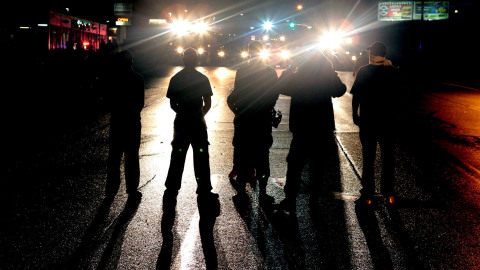
Source: NBC


The thing about Ferguson is... we are operating squarely within the confines of collective social and institutional memory. Trying to understand police use of force is complicated and difficult. I recommend to everyone that they review both the practices of Ferguson/St Louis County's PD's on their own merits, and the general guidelines on escalation-of-force protocols out there on the internet.

We still have a lot we don't know about the specifics in Michael Brown's death, though we all have our (widely varying) suspicions. We have more information about the Wallace shooting. But we don't know, so much as we feel, that these deaths must be understood in the context of broader trends in law enforcement and the sociological fabric of America. And that is extremely difficult to do, because many police departments and government entities don't appear interested in helping.

I have already spent a lot of Facebook real estate, on my own and others' walls, posting about Ferguson. I've talked with gun owners, police officers, social activists; country folk, city-dwellers; friends and strangers; liberals and conservatives; people of many colors. I've discussed the specifics of the Brown shooting, the relevance and impact of his purported robbery, the history of Ferguson PD, Wilson's background in a now-disbanded department, the feasibility or impossibility of non-lethal force in Wallace's death, the frequency and motivations of suicide-by-cop, and the broader challenges in combating racism in the American justice system -- the same stuff that hopefully all of us have been discussing and writing about.

I will therefore not go into that here. For the curious, suffice to say that, as a moderate social progressive, I think cops have it rough, but the black urban poor have it much rougher, and my empathy for officers runs smack into my belief that authority demands accountability. I also think the truth of the Brown incident probably lies in between the most extreme accounts, though where in between remains uncertain. But in a sense, the resolution of the Brown case shouldn't dominate a conversation about something this big. No one case can fully exemplify a national problem.

Because I think situations like this are always judgment calls in degrees, we can only really get a sense of what is and is not permissible, and desirable, in police behavior at a bird's-eye view. With that in mind, I present the following papers without comment. I did not collect them with a rhetorical goal in mind, and I have not even finished reading them myself. The only thing I'm confident they all had in common was they were written by scholars or analysts, and were subjected to peer review or solicited within the government. I just want to add something tangible to the conversation.

Note: hopefully some of these will be available to those who don't have access to University journal subscriptions. If nothing else, read the abstracts and skim the government-published pdf's. And of course, do your own research. After all, this isn't my area. I'm just trying to do what I can.


Jacobs D, Britt D (1979). Inequality and Police Use of Deadly Force: An Empirical Assessment of a Conflict Hypothesis. Social Problems 26(4).

Kaune MM, Tischler CA (1989). Liability in Police Use of Deadly Force. Am J Police 89.

National Criminal Justice Reference Service, National Institute of Justice: Use of Force by Police, Pt 2.
Garner JH, Maxwell CD. Ch 4, Measuring the Amount of Force Used By and Against the Police in Six Jurisdictions. 
Alpert GP, Dunham RG. Ch 5, The Force Factor: Measuring and Assessing Police Use of Force and Suspect Resistance.
Adams K. Ch 6, A Research Agenda on Police Use of Force.

Jacobs D, O’brien RM (1998). The Determinants of Deadly Force: A Structural Analysis of Police Violence. Am J Sociology 103(4).

Fyfe JJ (2006). Police use of deadly force: Research and reform. Justice Quarterly 5(2).

Klinger DA, Brunson RK (2009). Police officers’ perceptual distortions during lethal force situations: Informing the reasonableness standard. Criminology & Public Policy 8(1).

Bennett RR (1997). Excessive force: A comparative study of police in the Caribbean. Justice Quarterly 14(4).

Walker S (2007). Police Accountability: Current Issues and Research Needs. Presented at NIJ Policing Res Workshop, Washington DC (2006).

7.15.2014

FutureArt: protected by policy? Free but impoverished? Can we have it both ways?

I consider myself a perennial noob on the subject of artistic intellectual property, so I'm soliciting reactions to this piece from Vox (ignore the up-front questionnaire if it please you).
Hatsune Miku, Pop Star of the People.
hoangtush @ deviantart


I honestly feel very conflicted. On the one hand, I am a huge believer in the power of decreasing supply costs to increase living standards, and the internet and its access to information and information-based services strikes me as a big deal. Resistance to the abundance of valuable services on behalf of its producers seems to me like a great way to entrench dying industries and inhibit progress; consider the replacement of auto manufacturing jobs with robots, and my argument in that kind of paradigm.

On the other hand, I really dislike the idea that valuable art, writing, music, etc., usually produced on small scales long before an artist catches on and often never reaching the profitability of some inferior work, would lose yet more financial leverage (as my grad-school colleague Erik Hoel shared).

One hope that i have is that the democratization of art production will spur the spotlighting of worthwhile artists; in a certain sense Biebs is the ultimate example of this, ironically enough, if only because as an overall package he was valuable to the market. Indie bands stand to benefit as well, and Arcade Fire's grammy isn't discouraging. Plus if it's true that personality, not product, is the marketable good, then the weird genius of Hatsune Miku at least changes the conversation, even if it's not clear how.

Another friend and former classmate, Jason Myatt, has kicked around an idea with me about a simple safety net that pays people to devote 20 hours a week to a demonstrated productive activity -- intentional pipe dream/thought experiment though it is from a current-implementation perspective -- to me suggests a possible solution. At least, it does so if only in the sense that, once global distribution of keep-you-alive supplies evens out and death by starvation/exposure could (if we chose) become a thing of the past, then the need to create policy to preclude literal starving artists would likewise diminish, and the question is only whether an artist would become rich and famous, etc. Capitalism survives, but not sell-enough-goods-or-die capitalism.

Pseudo-Marxist utopia though Jason's thought experiment might seem to be, it strikes me as valuable in this context precisely because it accommodates, in ways that a low-safety-net system does not, the possibility of marketplaces for products with almost no overhead. If everybody can, at baseline, stay alive and build lives for themselves reasonably well, then why would we need to have crazy arguments about structurally protective art distribution practices? Incentives could adjust in response to what people really want to spend their lives doing, etc., etc.

This post is a bit rambly, and I don't have a clear point I'm driving home. I'm just wondering if the solution to these economic problems is, in a sense, more fundamentally, formally macroeconomic than it is about the morality of art consumption and merit. I know we can never divorce ethics and policy, but I'm curious whether we can frame it a bit more practically.


I fully expect several of my points are ignorant and idiotic, and eagerly await my edification!

12.27.2013

Forget Smarm and Snark. This is bigger than being ironic.

Note: Started this post a few weeks ago; now I've just come back and completed it.

I just finished eating lunch with Rich Brown, a faculty member in UW-Madison's Department of Family Medicine and the speaker for today's Neuroscience and Public Policy (NPP) seminar, and I have a curious case of the warm fuzzies. I'll be seeing him talk at 4.

For the past 24 hours -- that is, since walking out of a discussion section on the last seminar in the series, delivered by UW Life Sciences professor and wunderkind Dietram Scheufele -- I've been preoccupied with dark and gloomy thoughts on the state of the American political system. Research done by Scheufele, his colleague Dominique Brossard, and others on science communication has revealed some depressing implications for how we think informed dialogue and debate should go in the U.S. Basically, that body of work has exposed shortfalls in the so-called "deficit model" of public engagement in science: the idea that if only people were more familiar with the facts and figures, if only they knew what we who study an issue know, they would see things as we do and shake themselves loose of deeply-entrenched ideological positions.

As it turns out, that's not true. At the best, we've overestimated the persuasiveness of scientists or the open-mindedness of Americans (not to mention the possibility of being wrong in the first place). At worst, all the people who listen to evidence have already joined the team, and the people who remain are recalcitrant or simply subscribe to a different view on how facts matter in determining what is right and good. The extent to which new information changes their opinions tends to decrease with increased ideology and religiosity, though I'm not interested in falling head-over-heels into an ad hominem attack. The point is, we can't just sit people down in a room, show them the graphs, make sure they understand, and send them on their way to building a brighter, more rational world. We have probably been arrogant all along to believe academia has (or deserves?) that kind of power, at least to the extent the findings hold up.

You may have also heard some hubbub about comment sections, especially in science reporting, and how flamers and trolls really do distort people's perceptions of the science so they walk away with the wrong ideas. Again, that was Scheufele and Brossard.

At the end of Scheufele's lecture a couple weeks ago, the cameraman recording the talk for online access piped up during the Q&A session, saying that of the hundreds of lectures he'd thus recorded, this one was the most depressing. If the evidence suggests that many people just don't listen to facts and reason after all, how the heck are we going to solve the increasingly American problem of policy and politics divorced from reality-based solutions?

Scheufele, cheery and charming though he is, only said that his work identified a problem rather than posing a solution... and furthermore, he apologetically grimaced, he might be wrong?

Don't worry, I'll get back to Rich Brown and my warm fuzzies. Hang in there, I want you to get there with me.

------------------

So yesterday's discussion section, concerned with Scheufele's talk, was a lightning round of political philosophy, legal analysis, and fruitless efforts to pin the cause of the problem on anything or anyone in particular. My friend in the Neuroscience and Law program, Joe Wszalek, quite defensibly felt there existed enough precedent and latitude in the framers' views on tyranny of majority to see our current gridlock as an unusually bad case of democratic flu, rather than the first symptoms of something more sinister. I adopted the view that, to extend the conclusions of Hacker and Piersson's Winner-Take-All Politics (also mentioned in my last post), our system is approaching the state of a "solved game" such as Connect 4, in which there exists an opening-move strategy that can never lose. I argued that in the current situation, that solution stems from the convergence of three things:
  1. The American political system is designed so intently to check power that it is much more disposed to resist radical change than it is to adopt it, especially over the protests of a minority. It thus takes a lot less political will to keep things as they are than it does to change them.
  2. Our electoral mechanisms ensure the survival of a two-party political system, in which gridlock is basically inevitable as party territory will forever shift to accommodate changes in political attitudes until it reaches a sort of Nash equilibrium. It's not coincidence that Presidential elections are routinely won 51-49.
  3. One party has as its primary policy agenda the simple preservation of the status quo.
If that party chooses to use the leverage afforded them by our inertia-favoring system to enact inertia, they will rarely have to work harder than the other party or expend more political capital to win every fight they enter. This blog is not a book, at least not yet, so I will not go into a very long discussion on the particulars of my position, though I encourage you to research more on your own with Hacker & Pierson, and their skeptics, as a jumping-off point.

Then yesterday evening, I read this article in Gawker which introduced into the memetic lexicon a new (or at least, revitalized) buzzword, smarm, whose insidious spectre looms large over the internet's other favorite accusation, snark. In it Tom Scocco argued that, for all the legitimacy of complaints against needless snark in criticism, smarm -- a form of bulls**t characterized by hollow calls for civility and indignance at pettiness -- is the deadlier disease, for it can never be well-intentioned. It is "cynicism in practice," not in attitude, says Scocco, and he has a point. We all hate political talking points, even as we all acknowledge that in the current paradigm they're an inevitable part of playing the game. I, more than most progressives I hang around, insist we musn't dehumanize politicians and instead should blame the perverse incentives of this great big Connect 4 game we keep playing, but it doesn't change the fact that campaigns are more about (metaphorically, and maybe literally) gauging whether the median voter prefers McDonald's or Burger King than about what policies will best help the poor even eat there.

I even ended up reiterating with my girlfriend a previous debate we'd had about the character of politicians, the extent to which we should hate the players or the game, and whether it was even possible to run a nationally-visible campaign for public office primarily on evidence-based policy platforms.

Finally, this morning while putzing around waiting to meet Brown for lunch, my NPP colleague Princess Ojiaku bumped into me, and we talked about the implications of Scheufele's work and our fears that all this was intractable, despite my convictions that Americans are smart, deserve the smartest policies and politicians in the world, and would gladly bring all of it about given the chance. Even a follow-up to the discussion from our program's advisor, noting that researchers were working on ways to expose social media users to new ideas while still taking their preferences into account in generating newsfeeds, seemed like a concession prize; a footnote.

I was genuinely worried, for the first time in a long time, that nothing I or anyone else could do would stand a chance of changing all that. Princess and I left the building (which is dedicated to public and industry research cooperation), crossed University Ave. (on the campus of a school dedicated to sifting and winnowing for the truth and putting that truth to work for its state), and without remembering any of that, trudged down the hall towards the conference room for lunch.

----------------------

Richard Brown is a very nice guy, in a way that is both stereotypical and specific. Not a generic, neighbor-cuppa-sugar nice, but an I-bet-you're-interesting nice. He asked us about our research interests, and then he told us about his while we ate sandwiches. He's primarily interested in promoting the use of screening for mental health and substance use issues as a means of entry to interventions, which his research, done in collaboration with the La Follette School's Dave Weimer, has found to be a very effective way of ensuring that people get care they don't realize they need. He also told us about his favorite thing in the world, I'd judge: a style of medical support called Motivational Interviewing (MI). I'd heard of it, but I wasn't as familiar with it as I was with better-known tools in the therapist's toolkit -- Cognitive Behavioral Therapy, mindfulness therapy, etc. I remembered it had something to do with giving the patient more credit for their successes.

He explained that MI was a means of interacting with patients that focused on maintaining the patient's agency. Instead of hunting for poor health behavior, harping on potential adverse outcomes, and hammering the desired changes, MI is structured to help patients volunteer useful information, form discrete goals, and analyze their own health problems. In particular, it requires the clinician to be supportive, non-adversarial, and above all empathetic towards the patient. The doctor is there to be a guided sounding board, a source of information, and affirmatively supportive. Ultimately, the objective is to help patients resolve ambivalence, arrive at a goal, and then commit to the changes they need to make to reach that goal.

Here's why this is relevant. MI has been shown to be more effective than traditional clinical practice in a number of different settings since it was formulated in the early 80's by Miller & Rollnick. The man on whose work MI is based, Carl Rogers, developed the humanistic approach to psychological counseling, and was eventually nominated for a Nobel Peace Prize because of the applications of his methods to cross-cultural conflict resolution in places like South Africa and Northern Ireland.

In other words, MI represents the evolution of a rhetorical style whose central tenet is that perspective-taking and empathy are the keys to persuasion. Now, I've been lucky enough to study the mechanisms of empathy, and its role in psychopathy, in a terrific lab, and I've been treated to some of the most cutting-edge thinking in the academic world on the subject by collaborators. Empathy alone is not the only thing that separates most people from psychopaths, but it's a big part, and I freely admit it's an idea at the center of a lot of my personal pet theories. With that disclaimer out of the way, in my view MI provides a certain measure of validation for empathy as a fulcrum in facilitative social transactions. If it's true that the "deficit model" fails to predict the stubbornness of many Americans in the face of scientific evidence, the role of empathy in MI may explain what science communication lacks, and naturally suggest how we should change our approach.

If the "deficit model" were accurate, then any amount of accurate information a doctor provided a patient would cause the patient to behave in a more health-promoting way. The success of MI relative to a more confrontational approach indicates that's not the case. Similarly, whenever scientists or organizations antagonize people who seem to either lack or ignore evidence, perhaps they are unthinkingly making their own task harder. The distortion of understanding caused by vitriolic comment sections, which would seem to suggest there's power in the adversarial approach, could just as easily be interpreted as polarization in response to overzealous troll-hunting by defenders of science. If we really want to change people's minds, we cannot afford to frame science communication as an us-versus-them decision. Despite every temptation to do so, the evidence here seems to indicate that, at least at the mass level, and given the tools of social media we have at our disposal, the high road really is the only road. And in particular, starting with an understanding of where those we disagree with are coming from is an important technique for changing minds.

____________________

Here's the thing. Scocco's point in the Gawker article is that snark, while somewhat destructive, is at least honest, while smarm is disingenuous and amounts to misdirection in the pretended name of civility. Rhetoric is not a new field, nor is persuasion a new technique, and I realize that by choosing to focus on the work of a few current science policy experts I'm omitting literally millenia of thought on how to reach people who refuse to face the truth when it's available. But all I'm really trying to say is the following.

  • Ideological debate often precludes the implementation of science-based policy.
  • Freedom of religion and a commitment to independent thought make it unlikely science will simply overrun ideologues in the near future, when a lot of science-based policy would be most effective to implement.
  • Studies predict that convincing religious and ideological people of scientific fact is next to impossible.
  • But maybe we've just been doing it wrong, and doing it right means treating our ideological opponents with the respect we want for ourselves.
I know that extremists piss scientists off all the time. I know they even put people's lives in danger. I know they make town-hall meetings hair-raising experiences, and we've been trying to take the high road a long time. But if the contrast between internet flame wars and cooperative doctor-patient interactions provides any insight at all, it's that the fact that it's hard doesn't mean we can compromise on our good-faith efforts to do science outreach not just diplomatically, but empathetically.

That's where the warm fuzzies came from. Maybe the quest to build society around shared knowledge isn't as hopeless as we thought, and maybe all that cheesy stuff that gives you the warm fuzzies is a necessary part of the solution after all.

12.08.2013

Why Income Inequality Isn't About Preserving Jobs

A college friend of mine posted this article in the Guardian, by the creator of The Wire, on the drivers of economic inequality. It's a flash flood of an argument, a passionate and unintimidated review of why we can't expect capitalism to solve our social problems, even as it solves many of our economic ones. I enjoyed reading it and parts of it were terrific.

I think the bit that I liked the best is this:
If you watched the debacle that was, and is, the fight over something as basic as public health policy in my country over the last couple of years, imagine the ineffectiveness that Americans are going to offer the world when it comes to something really complicated like global warming. We can't even get healthcare for our citizens on a basic level. And the argument comes down to: "Goddamn this socialist president. Does he think I'm going to pay to keep other people healthy? It's socialism, mother****er."
What do you think group health insurance is? You know you ask these guys, "Do you have group health insurance where you …?" "Oh yeah, I get …" you know, "my law firm …" So when you get sick you're able to afford the treatment.
The treatment comes because you have enough people in your law firm so you're able to get health insurance enough for them to stay healthy. So the actuarial tables work and all of you, when you do get sick, are able to have the resources there to get better because you're relying on the idea of the group. Yeah. And they nod their heads, and you go "Brother, that's socialism. You know it is."
And ... you know when you say, OK, we're going to do what we're doing for your law firm but we're going to do it for 300 million Americans and we're going to make it affordable for everybody that way. And yes, it means that you're going to be paying for the other guys in the society, the same way you pay for the other guys in the law firm … Their eyes glaze. You know they don't want to hear it. It's too much. Too much to contemplate the idea that the whole country might be actually connected.
Granted, I think most people have a slightly more sophisticated register of complaints -- the idea that encouraging people to overuse the healthcare system will disincentivize good behavior, that dependence on the wealth of others means people won't allocate the correct part of their resources to preserving their own health, etc. etc. -- even if all of it washes out when you do the longhand math. I don't think it's outright obliviousness. But it's got punch.

So as I said, this is in many ways a really good article. What I think would make it better is a more nuanced view of the relationship between labor, equity and growth -- in particular, there's some incomplete reasoning in the part of the article my friend quoted, which reads as follows (preceding paragraph included):
I'm utterly committed to the idea that capitalism has to be the way we generate mass wealth in the coming century. That argument's over. But the idea that it's not going to be married to a social compact, that how you distribute the benefits of capitalism isn't going to include everyone in the society to a reasonable extent, that's astonishing to me.
And so capitalism is about to seize defeat from the jaws of victory all by its own hand. That's the astonishing end of this story, unless we reverse course. Unless we take into consideration, if not the remedies of Marx then the diagnosis, because he saw what would happen if capital triumphed unequivocally, if it got everything it wanted.
And one of the things that capital would want unequivocally and for certain is the diminishment of labour. They would want labour to be diminished because labour's a cost. And if labour is diminished, let's translate that: in human terms, it means human beings are worth less.
Okay, this is where I think we can make the biggest correction. The first paragraph? Absolutely. Couldn't agree more, as I'll expand on later. But in the second and third bits, I think we lose sight of the mechanics by which we actually grow.


apologies to un-self-aware patriots.
via knowyourmeme
The thing to remember is that in a political climate where Job Creation! is the only thing anyone's talking about, there is a headlong rush to artificially inflate industries that are no longer the most effective ways to, as Simon puts it, "create mass wealth." This is the knee-jerk policy reaction to the idea that labor should be diminished because it's a cost: no! we say, it should be promoted! We should build a stronger labor base by creating a bunch of jobs!

The problem is this: the improvement in our quality of life is in most ways a result of technological production multipliers. According to Robert Solow's Nobel Prize-winning work, economic growth in the early 20th century was due more to sci/tech innovations than to capital investment or growth in the workforce. The machines that make our cars faster than people, well, it's true that it puts auto workers out of work, but it also makes cars cheaper, which gives more people cars and the auto industry a broader customer base; that also allows for more investment in the auto industry, which may not counteract the potential loss in labor, but it results in the same amount of money in American pockets being able to acquire more wealth. (Econ nerds: I'm not gonna get into inflation and interest rates here, because even taking those into account we still see growth in whatever Consumer Price Index we choose. Correct me if I'm wrong.) Economic growth always looks a little like this: while we obviously care about the employment rate, we might not want to be primarily concerned with the number of people working in a particular industry, but rather with the participatory leverage afforded the people working in that industry. And anyway, it increasingly looks like the minimum wage doesn't affect employment rates much in the U.S., so we're already set to lift the floor in that regard.

This is why Bangladesh is almost entirely employed by the garment industry right now -- it's a better economic engine than subsistence farming, but they don't yet have access to the more lucrative industries that are available here and elsewhere in the developed world. They may soon, however, as the increased income due to the greater workforce production makes Bangladeshis able to seriously contemplate education, entrepreneurship, and the greater opportunities that follow. South Korea looked in the 70's like Bangladesh does today, and now look at them.

The point is this: as economies advance, they (in theory) should replace the harder, more dangerous, more repetitive jobs with healthier, safer, more fulfilling and self-directed ones. We ABSOLUTELY need a better social compact, because as the economy advances and that turnover occurs, people working in jobs at the "bottom" will be more vulnerable than people working in jobs in the middle or the top. There's some (inconclusive) reason to believe income inequality is not just unjust, it actually hurts economic growth (or at least, it doesn't help), and forgetting either point means we do ourselves and our most needy a huge disadvantage. However, the social compact also can't freeze the economy in place by refusing to shift toward more humane, more productive opportunities for fear of losing the Triangle Shirtwaist Factories of the world -- it just has to ensure that, as we  produce more growth and make possible a higher standard of living, that everyone has the opportunity to REACH that standard of living, even when they're at a disadvantage. Otherwise, we'll create a more equitable society, but we'll stop making progress as a country.


These countries had similar growth over the same period. So.
Hacker & Pierson (2010), via MotherJones

By the way, that increased wealth should also give us the opportunity to engage in work lifting the rest of the world out of poverty, as well as those Americans who have been left out of the social compact up to this point. You don't need to be a Marxist to see that. The social compact is about fairness, but fairness is also about what works. Unfair systems eventually either collapse or get brought down by Simon's proverbial riot-brick, whether monarchy, slavery or every step in the fight for civil rights -- and that's because people who are oppressed do have value. They continue to be worth not less, but more. An economy that's fair is an economy that harnesses all its members' potential, that gives them the greatest part of the world they can get, and that includes mechanisms that ensure we help each other to do so. That's how we grow.

So to Simon I would say this: fairness matters, both morally and practically. Labor unions are important, as is advocacy for the disadvantaged and disenfranchised in every city and state, and in every year. But part of the reason a social compact, a supportive safety net, is so necessary is that economic growth isn't equally fair to everybody. We need to recognize that if we want to grow, we need to be sure we are fair to the people who lose out, and help them get back where they want to be.

So I want policymakers to stop obsessing over job creation, or fearing backlash when jobs are lost to technological advancement, because in many ways artificial job creation is just a totally inadequate substitute for a deteriorating social safety net, and the connectedness and mutual understanding that it represents. Don't save or create already-obsolete jobs for poor people -- help poor people live well and get good jobs.


***


As a footnote, check out the work my former classmates did on the "skills gap" in Wisconsin. It turned out that the dominant political narrative in the state, that there weren't enough technically skilled people for a 21st century labor market, may be backwards -- we may have such a top-heavy group of skilled people that everyone is working in a job they're overqualified for, and people who are actually best suited for lower-skill jobs just get pushed out of the economy entirely. So we also need to be careful to research where those people who are screwed by economic turnover are, what their lives look like, so that we can put our support where it needs to go.

As a second footnote, if you want to REALLY go down the rabbit-hole, you can read some thoughts about what happens when you let ideas with a capitalist flavor spill out of economics into social policy. This is a review of a book by a scholar I'm a fan of, Bernard Harcourt, in the Harvard Law Review; but not only is it a neat summary of Harcourt's theories on how free-market capitalism encourages high levels of incarceration (no, seriously!), but it's an even-keeled look at the related literature as well. I did not know this was a thing, and I'm even more surprised that it doesn't sound completely crazy when it gets into the nitty-gritty of labor markets.